Mobile Applications
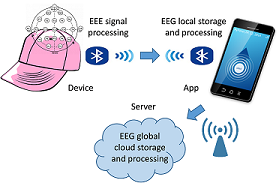 This is a plethora of small, related research projects. The first one
was a collaborative pilot project with Drs. Rodrigo Romero and Sergio
Cabrera of ECE, entitled HifoCap: A Wearable System for Detecting
High Frequency Oscillations in EEGS of the Human Brain.
The goal of the project was to investigate a wearable system for
automatic detection of scalp high frequency oscillations (HFO). A
wearable HifoCap device (cap) senses cortical signals and processes
them with an embedded system. The main processing steps include
amplification, filtering, and HFO detection. EEG waves containing HFOs
are wirelessly transmitted to a smart phone (or tablet) using a
personal area network protocol such as Bluetooth. An app running on
the smart phone receives EEG waves for recording, time stamping,
plotting, logging, and wireless transmission using a local area
network protocol such as IEEE 802.11 to a cloud storage server. A
future generation of the system may include full raw data acquisition
and storage in a cloud server to support multiple types of off-line
analysis.
This is a plethora of small, related research projects. The first one
was a collaborative pilot project with Drs. Rodrigo Romero and Sergio
Cabrera of ECE, entitled HifoCap: A Wearable System for Detecting
High Frequency Oscillations in EEGS of the Human Brain.
The goal of the project was to investigate a wearable system for
automatic detection of scalp high frequency oscillations (HFO). A
wearable HifoCap device (cap) senses cortical signals and processes
them with an embedded system. The main processing steps include
amplification, filtering, and HFO detection. EEG waves containing HFOs
are wirelessly transmitted to a smart phone (or tablet) using a
personal area network protocol such as Bluetooth. An app running on
the smart phone receives EEG waves for recording, time stamping,
plotting, logging, and wireless transmission using a local area
network protocol such as IEEE 802.11 to a cloud storage server. A
future generation of the system may include full raw data acquisition
and storage in a cloud server to support multiple types of off-line
analysis.
 Our research team, consisting of Oliver Singayigaya (MSSwE), Javier
Garcia (MSEng), John Ramirez (BS), Brian Adriana Escobar (BS), and
Brain Espinosa (BS), was responsible for developing an Android app for
EEG data visualization and cloud server transfer. We identified many
interesting challenges in developing a data intensive, soft real time
system on non-dedicated Android devices such as smartphones and
tablets. We classified these challenges based on their causes, e.g.,
interrupts such as incoming calls and notifications, lack of control
on app's lifecycle (especially, suspension and destruction), garbage
collection, high communication bandwidth (1.96 Mbps), long and
continuous running, and network coverage outage. We proposed possible
solutions to some of these challenges -- e.g., disabling/removing
unpredictable services, minimizing the garbage collection time,
selective decoding and visualization of EEG samples, optimization of
network I/O, and light UI -- and showed the effectiveness of the
proposed solutions by developing a prototype [Cheon, Romero and Garcia
2017]. We also observed and learned that the best practices for
writing Java programs are not always best practices for Android
applications [Cheon 2016]. They can be sources of memory performance
issues [Escobar and Cheon 2017].
Our research team, consisting of Oliver Singayigaya (MSSwE), Javier
Garcia (MSEng), John Ramirez (BS), Brian Adriana Escobar (BS), and
Brain Espinosa (BS), was responsible for developing an Android app for
EEG data visualization and cloud server transfer. We identified many
interesting challenges in developing a data intensive, soft real time
system on non-dedicated Android devices such as smartphones and
tablets. We classified these challenges based on their causes, e.g.,
interrupts such as incoming calls and notifications, lack of control
on app's lifecycle (especially, suspension and destruction), garbage
collection, high communication bandwidth (1.96 Mbps), long and
continuous running, and network coverage outage. We proposed possible
solutions to some of these challenges -- e.g., disabling/removing
unpredictable services, minimizing the garbage collection time,
selective decoding and visualization of EEG samples, optimization of
network I/O, and light UI -- and showed the effectiveness of the
proposed solutions by developing a prototype [Cheon, Romero and Garcia
2017]. We also observed and learned that the best practices for
writing Java programs are not always best practices for Android
applications [Cheon 2016]. They can be sources of memory performance
issues [Escobar and Cheon 2017].
We recently become more interested in applying established software
engineering principles, techniques, and methods to mobile application
developments [Cheon 2012]. Examples include applications of
model-driven development [Cheon and Barua 2018] multiplatform
application development [Speicher and Cheon 2018] [Cheon 2019], and
code reuse [Cheon, Chavez and Castro 2019].
-
Yoonsik Cheon,
Carlos Chavez and Ubaldo Castro.
Code Reuse between Java and Android Applications,
Proceedings of the 14th International Conference on Software
Technologies (ICSOFT),
Prague, Czech Republic,
July 26-28, 2019, pages 246-253.
[DOI:
10.5220/0007843702460253]
[PDF]
-
Yoonsik Cheon.
Multiplatform Application Development for Android and Java.
17th IEEE/ACIS International Conference
on Software Engineering, Management and Applications,
Honolulu, Hawaii, May 29-31, 2019.
[PDF]
-
Terry J. Speicher and
Yoonsik Cheon,
Composing a Cross-platform Development Environment
Using Maven,
Workshop on Regional Consortium for Foundations, Research
and Spread of Emerging Technologies in Computing Sciences,
Juarez, Mexico, Nov. 8-9, 2018, pp. 68-80.
[PDF]
-
Yoonsik Cheon
and Aditi Barua.
Model Driven Development for Android Apps.
Proceedings of the 2018 International Conference
on Software Engineering Research & Practice,
Las Vegas, Nevada, July 30 - August 2, 2018,
pages 17-22.
[PDF]
-
Adriana Escobar De La Torre and
Yoonsik Cheon,
Impacts of Java Language Features on the Memory Performances
of Android Apps,
Technical Report 17-84, Department of Computer Science,
University of Texas at El Paso, El Paso, TX, September 2017.
[PDF]
-
Yoonsik Cheon,
Rodrigo Romero, and Javier Garcia,
HifoCap: An Android App for Wearable Health Devices,
Advances in Digital Technologies, Proceedings of
the 8-th International Conference on Applications of
Digital Information and Web Technologies,
Volume 295 of Frontiers in Artificial Intelligence
and Applications, pages 178--192, IOS Press, 2017.
[DOI:
10.3233/978-1-61499-773-3-178]
-
Yoonsik Cheon,
Are Java Programming Best Practices Also Best Practices
for Android?
Technical Report 16-76, Department of Computer Science,
University of Texas at El Paso, El Paso, TX, December 2016.
[PDF]
-
Yoonsik Cheon,
Extending Java for Android Programming,
International Conference
on Software Engineering Research and Practice,
Las Vegas, Nevada, July 16-19, 2012.
[PDF]
Last modified: $Id: mobileapp.html,v 1.3 2019/08/17 09:23:44 cheon Exp $